
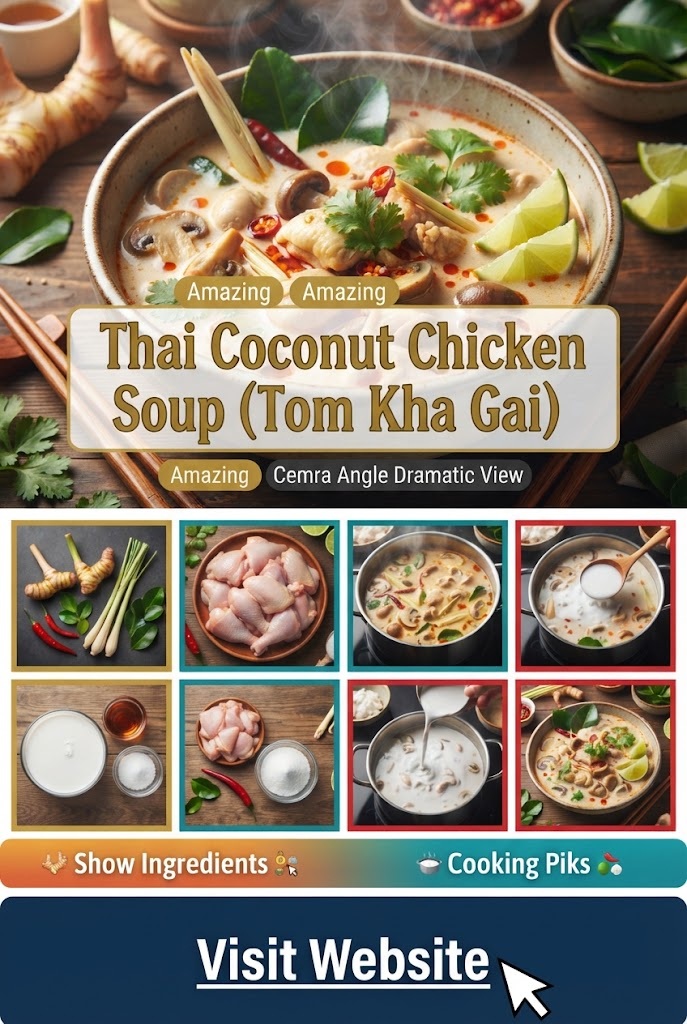
Thai Coconut Chicken Soup (Tom Kha Gai): A Complete, Authentic-Style Recipe
Thai Coconut Chicken Soup, commonly known as Tom Kha Gai (ต้มข่าไก่), is one of Thailand’s most beloved soups. It combines creamy coconut milk with aromatic lemongrass, galangal, makrut lime leaves, chilies, mushrooms, chicken, lime juice, and fish sauce. The result is a soup that is simultaneously creamy, sour, salty, spicy, aromatic, and slightly sweet.
Unlike many Western cream-based soups, Tom Kha Gai gets its richness from coconut milk rather than dairy cream. The soup should taste bright and fragrant rather than heavy. The distinctive flavor comes from galangal, which is related to ginger but has a sharper, more citrusy and peppery character.
This detailed recipe explains the ingredients, preparation, cooking process, flavor balancing, substitutions, serving suggestions, storage, reheating, common mistakes, and tips for making excellent Tom Kha Gai at home.
What Is Tom Kha Gai?
The Thai name gives us a useful description:
- Tom means boiled or cooked in a broth.
- Kha means galangal.
- Gai means chicken.
So, Tom Kha Gai can essentially be understood as chicken soup flavored with galangal.
Traditional versions are built around a fragrant broth infused with galangal, lemongrass, and makrut lime leaves. Coconut milk is then incorporated to create the characteristic creamy appearance and mouthfeel.
The soup is not simply coconut milk with chicken added to it. The aromatic ingredients are extremely important. If you use only coconut milk, chicken, and lime juice, you may get a tasty coconut chicken soup, but it will lack the distinctive character of Tom Kha Gai.
A well-balanced bowl should have several flavors working together:
Creamy + sour + salty + spicy + aromatic + mildly sweet
No single flavor should completely dominate.
Why You’ll Love This Recipe
Tom Kha Gai is an excellent choice when you want something comforting but still fresh and flavorful.
It is rich without being too heavy
Coconut milk gives the soup a luxurious texture, but lime juice and fresh herbs keep it bright.
It is packed with aroma
Lemongrass, galangal, and makrut lime leaves perfume the broth as they simmer.
It is quick to prepare
Once the ingredients are prepared, the actual cooking process is relatively short.
It is customizable
You can make it:
- Mild or very spicy
- More sour or less sour
- Creamier or brothier
- With chicken breast or chicken thighs
- With extra mushrooms
- With vegetables
- Without fish sauce
- Vegetarian
- Vegan
It works beautifully as a complete meal
Serve it with steamed jasmine rice and you have a satisfying lunch or dinner.
Complete Ingredient List
The following quantities make approximately 4 generous servings.
For the Soup
| Ingredient | Amount |
|---|---|
| Boneless, skinless chicken thighs | 500 g |
| Coconut milk | 400 ml |
| Chicken stock or water | 500 ml |
| Fresh galangal | 40–50 g |
| Lemongrass | 2–3 stalks |
| Makrut lime leaves | 5–6 leaves |
| Fresh mushrooms | 200–250 g |
| Thai bird’s-eye chilies | 2–5 |
| Fish sauce | 2–3 tablespoons |
| Fresh lime juice | 2–3 tablespoons |
| Sugar | 1–2 teaspoons |
| Shallot | 1 small |
| Fresh cilantro | ½ cup |
| Fresh Thai basil, optional | ¼ cup |
| Neutral cooking oil | 1 teaspoon |
| Salt | As needed |
The exact quantities can be adjusted according to your taste.
Ingredient Details
Understanding the ingredients makes it much easier to reproduce the characteristic flavor of the dish.
1. Chicken
Chicken thighs are my preferred choice because they remain juicy and tender during cooking.
Chicken breast can also be used. However, breast meat can become dry if it is boiled aggressively or cooked for too long.
Cut the chicken into thin, bite-sized slices. Smaller pieces cook quickly and absorb the flavors of the broth.
Best option
Boneless chicken thighs
Alternative
Boneless chicken breast
If using chicken breast, be particularly careful not to overcook it.
2. Coconut Milk
Coconut milk provides the creamy body of Tom Kha Gai.
Use unsweetened full-fat coconut milk if possible. Avoid coconut cream unless you specifically want a much richer soup.
Do not confuse coconut milk with:
- Coconut water
- Sweetened coconut milk
- Cream of coconut
Those products are different and are not appropriate substitutes for ordinary unsweetened coconut milk in this recipe.
3. Galangal
Galangal is arguably the most important distinctive ingredient in Tom Kha Gai.
It resembles ginger, but it does not taste exactly like ginger. Galangal is more:
- Peppery
- Floral
- Citrus-like
- Sharp
- Aromatic
Fresh galangal gives the most authentic flavor.
If fresh galangal is unavailable, frozen galangal is generally preferable to dried powdered galangal.
Can ginger be substituted?
Yes, if necessary. However, the flavor will change.
Use ginger only as a backup because Tom Kha is specifically associated with galangal.
4. Lemongrass
Lemongrass contributes a fresh lemony fragrance without simply making the soup taste like lemon.
Use fresh stalks whenever possible.
To prepare lemongrass:
- Remove the dry outer layers.
- Cut away the hard bottom end.
- Trim the upper grassy section.
- Bruise the stalk using the side of a knife or a heavy utensil.
- Cut it into large pieces.
The pieces can be large because they are mainly used to flavor the broth rather than eaten.
5. Makrut Lime Leaves
Makrut lime leaves provide an intensely fragrant citrus aroma.
They are not the same as ordinary lime leaves or lime zest.
Use fresh or frozen makrut lime leaves when available.
Before adding them to the soup, tear or lightly crush them. This releases more of their aromatic oils.
Because the leaves are tough, they are generally removed before serving or simply left in the bowl as an aromatic garnish.
6. Mushrooms
Mushrooms provide texture and savory depth.
Common choices include:
- Straw mushrooms
- Oyster mushrooms
- Shiitake mushrooms
- Button mushrooms
- Cremini mushrooms
- Enoki mushrooms
Straw mushrooms are especially common in Thai-style soups.
Oyster mushrooms are an excellent substitute and are widely available.
7. Chilies
Thai bird’s-eye chilies provide heat.
For a mild soup, use 1–2 chilies.
For medium heat, use 3–4.
For a spicy version, use 5 or more.
You can also crush the chilies rather than slicing them. Crushing releases more heat and flavor into the soup.
8. Fish Sauce
Fish sauce supplies saltiness and deep savory flavor.
It is an important ingredient in traditional Tom Kha Gai.
Fish sauce is powerful, so add it gradually.
Different brands vary considerably in saltiness. Therefore, the recipe should be treated as a starting point rather than an absolute measurement.
9. Lime Juice
Fresh lime juice gives Tom Kha Gai its essential sourness.
Always add most of the lime juice near the end of cooking.
If you boil lime juice for a long time, its fresh citrus character can become dull.
Freshly squeezed lime juice is strongly recommended.
10. Sugar
A small amount of sugar helps balance the sourness, saltiness, and chili heat.
You do not want the soup to taste sweet.
Sugar is used here as a balancing ingredient rather than as the primary flavor.
Palm sugar is an excellent choice if available.
11. Cilantro
Fresh cilantro gives the finished soup a fresh herbal character.
Add it at the end rather than boiling it for a long time.
Preparing the Ingredients
Good preparation makes the cooking process much easier.
Prepare the Chicken
Trim any excessive fat from the chicken thighs.
Slice the chicken into thin pieces approximately 1–2 cm wide.
Set aside.
Prepare the Galangal
Wash the galangal thoroughly.
You can peel it lightly if the skin is particularly tough.
Slice it into thin rounds.
You do not need to mince it.
Large slices are easier to remove from the soup later.
Prepare the Lemongrass
Trim the stalks.
Bruise them firmly.
Cut each stalk into approximately 5–7 cm pieces.
Prepare the Lime Leaves
Remove the tough central stem if desired.
Tear the leaves into smaller pieces.
This helps release their aroma.
Prepare the Mushrooms
Clean the mushrooms.
If using oyster mushrooms, tear them into bite-sized pieces.
If using button or cremini mushrooms, slice them.
If using shiitake mushrooms, remove particularly tough stems.
Prepare the Chilies
Slice the chilies for a more controlled heat.
Alternatively, lightly crush them with the side of a knife.
Remember to wash your hands thoroughly after handling hot chilies and avoid touching your eyes.
How to Cook Tom Kha Gai
Now we come to the most important part: the cooking process.
The goal is not simply to boil everything together.
The soup develops its best flavor when the aromatic ingredients are gently infused into the liquid before the final seasoning is added.
Step 1: Prepare the Aromatic Broth
Place a medium-sized saucepan over medium heat.
Add the chicken stock or water.
Add:
- Galangal
- Lemongrass
- Makrut lime leaves
- Shallot
- Chilies
Bring the liquid gently toward a simmer.
Do not immediately turn the heat to high.
The aromatic ingredients need time to release their flavors.
Step 2: Simmer the Aromatics
Once the broth begins simmering, reduce the heat.
Allow the aromatics to gently simmer for approximately 8–10 minutes.
You should begin to notice a strong fragrance from the galangal, lemongrass, and lime leaves.
Do not worry if the broth looks relatively plain at this stage.
Most of the visual richness comes later when the coconut milk is added.
Step 3: Add the Chicken
Add the sliced chicken to the aromatic broth.
Stir gently to separate the pieces.
Allow the chicken to cook over a gentle simmer.
Depending on the thickness of the slices, this should take approximately 5–8 minutes.
Avoid rapidly boiling the chicken.
A gentle simmer produces more tender chicken.
Step 4: Add the Mushrooms
Once the chicken is nearly cooked, add the mushrooms.
Cook for another 3–5 minutes, or until the mushrooms are tender but still have some texture.
Do not overcook them into a soft, mushy texture.
Step 5: Add Coconut Milk
Lower the heat.
Pour in the coconut milk.
Stir gently.
Allow the soup to heat until it is steaming and just beginning to simmer.
Important:
Do not aggressively boil coconut milk.
A violent boil can cause the coconut milk to separate and produce a less attractive texture.
Gentle heat is better.
Step 6: Season With Fish Sauce
Add approximately 2 tablespoons of fish sauce.
Stir.
Taste the soup.
If it needs more saltiness or savory depth, add another small amount.
Remember that you will still add lime juice, which changes the perceived balance.
Step 7: Add Sugar
Add approximately 1 teaspoon of sugar.
Stir until dissolved.
Taste.
If the soup is extremely sour or spicy, a little additional sugar may help balance it.
Do not add too much.
The finished soup should not taste sugary.
Step 8: Add Lime Juice
Turn the heat to low or remove the saucepan from the heat.
Add fresh lime juice.
Start with approximately 2 tablespoons.
Stir and taste.
Add more lime juice if necessary.
This is one of the most important steps in making a good Tom Kha Gai.
The soup should have a noticeable sourness, but it should not taste like straight lime juice.
Step 9: Taste and Balance
Now taste the entire soup.
Ask yourself:
Is it salty enough?
If not, add a little fish sauce.
Is it sour enough?
If not, add a little more lime juice.
Is it too sour?
Add a tiny amount of sugar or coconut milk.
Is it too spicy?
Add more coconut milk or stock.
Is it too rich?
Add a little additional stock and lime juice.
Is it too thin?
Allow it to warm gently for a little longer, or increase the coconut milk slightly.
Is it too thick?
Add more stock.
The objective is balance.
Step 10: Finish With Fresh Herbs
Add chopped cilantro immediately before serving.
Thai basil can also be added if desired.
Give the soup a gentle stir.
Do not boil the herbs.
Step 11: Serve
Ladle the soup into warm bowls.
Make sure each serving contains:
- Chicken
- Mushrooms
- Coconut broth
- Chili
- Aromatic ingredients
You can garnish with:
- Fresh cilantro
- Sliced red chili
- Lime wedges
- Thinly sliced green onion
- Fresh Thai basil
Serve immediately.
Complete Recipe at a Glance
Yield
4 servings
Preparation Time
Approximately 20 minutes
Cooking Time
Approximately 20–25 minutes
Total Time
Approximately 40–45 minutes
Ingredients
- 500 g boneless chicken thighs, thinly sliced
- 400 ml full-fat unsweetened coconut milk
- 500 ml chicken stock or water
- 40–50 g fresh galangal, sliced
- 2–3 lemongrass stalks, bruised and cut into pieces
- 5–6 makrut lime leaves, torn
- 200–250 g mushrooms
- 2–5 Thai bird’s-eye chilies
- 1 small shallot, sliced
- 2–3 tablespoons fish sauce
- 2–3 tablespoons fresh lime juice
- 1–2 teaspoons sugar or palm sugar
- ½ cup fresh cilantro
- ¼ cup Thai basil, optional
- Salt, if needed
Cooking Method
- Prepare the chicken and slice it into thin pieces.
- Prepare the galangal, lemongrass, lime leaves, mushrooms, shallot, and chilies.
- Bring the chicken stock or water to a gentle simmer.
- Add galangal, lemongrass, lime leaves, shallot, and chilies.
- Simmer for 8–10 minutes.
- Add the sliced chicken.
- Simmer gently for 5–8 minutes.
- Add mushrooms.
- Cook for another 3–5 minutes.
- Reduce the heat.
- Add coconut milk.
- Warm gently without aggressively boiling.
- Add fish sauce.
- Add sugar.
- Remove from high heat.
- Add fresh lime juice.
- Taste and adjust salt, sourness, sweetness, and spice.
- Add fresh cilantro.
- Serve hot.
The Secret to Authentic-Tasting Tom Kha Gai
The biggest secret is balance.
Many homemade versions make one of several mistakes:
- Too much coconut milk
- Too much lime juice
- Too much fish sauce
- Not enough galangal
- Too much sugar
- Too little acidity
- Excessive chili
- Boiling the coconut milk too aggressively
Tom Kha Gai should be rich, but not overwhelmingly creamy.
It should be sour, but not painfully acidic.
It should be salty, but not unpleasantly salty.
It should be spicy, but the heat should not completely hide the aromatics.
The ingredients should support each other.
Traditional Flavor Balance
A useful way to think about Tom Kha Gai is as a flavor equation:
Coconut milk = richness
Galangal + lemongrass + lime leaves = aroma
Fish sauce = salt + umami
Lime juice = acidity
Chilies = heat
Sugar = balance
Chicken + mushrooms = substance and savory character
If one element is missing, the soup may taste flat.
Chicken Breast vs. Chicken Thigh
Both work well, but they behave differently.
Chicken Thigh
Advantages:
- More flavorful
- Juicier
- More forgiving
- Less likely to dry out
This is my first choice.
Chicken Breast
Advantages:
- Leaner
- Mild flavor
- Easy to slice
The disadvantage is that it can become dry if overcooked.
If using breast meat, keep the pieces thin and cook them gently.
Can You Use Rotisserie Chicken?
Yes.
If you already have cooked chicken, you can use it.
Prepare the aromatic broth first.
Add mushrooms and coconut milk.
Then add shredded or sliced cooked chicken toward the end, just long enough to heat it through.
This method is especially useful for a quick weeknight meal.
Vegetarian Tom Kha
Tom Kha can easily be adapted.
Replace chicken with additional mushrooms and vegetables.
Good choices include:
- Oyster mushrooms
- Shiitake mushrooms
- Straw mushrooms
- Tofu
- Baby corn
- Snow peas
- Bell peppers
Replace chicken stock with vegetable stock.
Most importantly, replace fish sauce with a suitable vegetarian seasoning such as light soy sauce or another savory alternative.
The resulting soup is often called a vegetarian or mushroom Tom Kha.
Vegan Tom Kha
For a vegan version:
- Use vegetable stock.
- Replace chicken with mushrooms and/or tofu.
- Replace fish sauce with soy sauce or another vegan umami seasoning.
- Check that the coconut milk and other packaged ingredients contain no animal-derived additives.
The aromatic foundation remains essentially the same.
How Spicy Should Tom Kha Gai Be?
There is no single required level of heat.
Thai food is often customized according to personal preference.
For a family-friendly version, begin with two chilies.
For a moderately spicy version, use three to five.
If you love very spicy food, you can add more.
It is usually easier to increase heat than to remove it, so start conservatively.
How to Make Tom Kha Gai Creamier
If you prefer an especially creamy soup, increase the coconut milk slightly.
For example, you could use:
500 ml coconut milk + 400 ml stock
instead of:
400 ml coconut milk + 500 ml stock
However, don’t automatically assume that more coconut milk means better Tom Kha.
Too much coconut milk can cover the delicate aroma of the galangal, lemongrass, and lime leaves.
How to Make It More Brothy
If you prefer a lighter soup:
- Reduce coconut milk.
- Increase stock.
- Keep the aromatics generous.
- Maintain enough lime juice and fish sauce to preserve the flavor.
A brothier Tom Kha can be particularly refreshing.
Common Mistakes to Avoid
Mistake 1: Using Only Ginger
Ginger is a reasonable substitute when galangal cannot be found, but it does not provide the same flavor.
If authentic character is important, look for fresh or frozen galangal.
Mistake 2: Adding Lime Juice Too Early
Lime juice is best added near the end.
This preserves its fresh, bright character.
Mistake 3: Boiling Coconut Milk Hard
Keep the soup at a gentle simmer.
Aggressive boiling can cause the coconut milk to separate.
Mistake 4: Overcooking Chicken
Chicken does not need a long cooking time when sliced thinly.
Overcooking creates dry meat, especially if using chicken breast.
Mistake 5: Making It Too Sweet
Tom Kha should not taste like a sweet coconut dessert.
Sugar is there to balance acidity and spice.
Use a small amount.
Mistake 6: Adding Too Much Fish Sauce
Fish sauce becomes more noticeable as the soup concentrates.
Add it gradually.
Taste after each addition.
Mistake 7: Using Bottled Lime Juice
Fresh lime juice gives a brighter and more natural flavor.
Bottled lime juice can work in an emergency, but fresh is strongly preferred.
Mistake 8: Cutting the Aromatics Too Small
Galangal, lemongrass, and lime leaves are primarily there to flavor the broth.
Large pieces make them easier to remove.
How to Make Tom Kha Gai Ahead of Time
You can prepare the soup in advance.
For best results, prepare the soup without adding all of the final lime juice.
Refrigerate it after cooling appropriately.
When ready to serve:
- Reheat gently.
- Add fresh lime juice.
- Taste.
- Adjust fish sauce and sugar.
- Add fresh cilantro.
- Serve.
This gives the finished soup a fresher flavor.
Storage
Store leftover Tom Kha Gai in a sealed container in the refrigerator.
For best quality, consume it within approximately 3–4 days.
Because the soup contains chicken and coconut milk, cool and refrigerate leftovers promptly rather than leaving them at room temperature for extended periods.
Reheating Instructions
Reheat gently on the stovetop over medium-low heat.
Stir occasionally.
Avoid bringing the soup to a vigorous boil.
If the soup has thickened in the refrigerator, add a small amount of water or stock.
After reheating, taste it again.
The flavors can change after refrigeration, so you may want to add a little fresh lime juice or fish sauce.
Can Tom Kha Gai Be Frozen?
Yes, although the texture may change slightly.
Coconut milk can sometimes separate after freezing and thawing.
If you plan to freeze it, cool the soup properly and store it in an airtight freezer-safe container.
Leave some space at the top because liquid expands during freezing.
Thaw in the refrigerator.
Reheat gently and stir well.
If the texture appears slightly separated, gentle whisking or stirring can help bring it back together.
Adding a small amount of fresh coconut milk after reheating can also improve the texture.
What to Serve With Tom Kha Gai
Tom Kha Gai is excellent with steamed jasmine rice.
The rice absorbs the fragrant coconut broth and makes the meal more filling.
Other possibilities include:
- Thai jasmine rice
- Brown rice
- Sticky rice
- Rice noodles
- Steamed vegetables
- Thai cucumber salad
- Fresh herbs
For a complete Thai-inspired meal, serve the soup alongside a simple rice dish and a fresh vegetable or salad preparation.
How to Serve It for Guests
If serving Tom Kha Gai for a dinner party, prepare the aromatic broth in advance.
Keep the chicken, mushrooms, coconut milk, and final seasonings ready.
Shortly before serving:
- Reheat the broth.
- Add chicken.
- Add mushrooms.
- Add coconut milk.
- Season.
- Add lime juice.
- Garnish.
- Serve immediately.
This makes it much easier to produce a fresh-tasting soup for several people.
Scaling the Recipe
The recipe is easy to multiply.
For 8 servings, approximately double everything.
However, don’t automatically double the lime juice, fish sauce, and chilies all at once.
Start with approximately double the quantities and then taste.
Seasoning should always be adjusted according to the actual volume and ingredients.
A Simple Tom Kha Gai Formula
If you want to remember the recipe without memorizing every measurement, think in five stages:
1. Infuse
Stock + galangal + lemongrass + lime leaves + chilies
2. Cook
Chicken + mushrooms
3. Enrich
Coconut milk
4. Season
Fish sauce + sugar
5. Brighten
Fresh lime juice + cilantro
That simple structure makes the recipe much easier to remember.
Frequently Asked Questions
Is Tom Kha Gai the same as Tom Yum?
No.
Both are famous Thai soups and share some aromatic ingredients, but they are different dishes.
Tom Yum is generally characterized by a more prominent hot-and-sour broth.
Tom Kha Gai is characterized by coconut milk and galangal, producing a creamy and aromatic soup.
Can I make Tom Kha Gai without galangal?
Yes, but the flavor will not be exactly traditional.
If you cannot find galangal, ginger can be used temporarily.
A mixture of ginger and a little additional lemongrass can help create a more complex substitute, but fresh galangal remains the preferred ingredient.
Can I use canned mushrooms?
Yes.
Canned straw mushrooms are particularly convenient.
Drain and rinse them before adding them to the soup.
Because canned mushrooms are already cooked, they generally need only a short time to heat through.
Can I use coconut cream?
You can, but coconut cream is considerably richer than standard coconut milk.
If using it, dilute it with additional stock or water according to your preferred consistency.
Can I make it without fish sauce?
Yes.
For a non-fish version, use a suitable soy-based or vegetarian seasoning.
The flavor will differ somewhat from traditional Tom Kha Gai.
Why did my coconut milk separate?
This usually happens because the coconut milk was exposed to excessive heat or boiled aggressively.
It is not necessarily a sign that the soup is spoiled.
Stirring can sometimes bring some of the texture back together.
Why does my soup taste flat?
Usually one of the key flavor elements is missing.
Try tasting it carefully.
It may need:
- More fish sauce for saltiness
- More lime juice for acidity
- More galangal/lemongrass infusion for aroma
- More chili for heat
- A tiny amount of sugar for balance
Add small amounts and taste after every adjustment.
Professional Tips for Better Results
Use fresh aromatics
Fresh galangal, lemongrass, and makrut lime leaves make a dramatic difference.
Don’t rush the aromatic infusion
Give the aromatics several minutes to flavor the stock before adding the other ingredients.
Slice chicken thinly
Thin slices cook quickly and evenly.
Keep the heat moderate
Gentle cooking produces a cleaner, more delicate soup.
Add lime at the end
This keeps the acidity fresh.
Taste before serving
Thai soups are designed around balance, so seasoning should be adjusted according to taste.
Don’t overload the soup
Too many vegetables or too much chicken can turn the soup into a generic coconut stew and obscure its aromatic character.
Restaurant-Style Presentation
For an attractive presentation, use shallow soup bowls or traditional Thai-style serving bowls.
Place several pieces of chicken and mushrooms in each bowl.
Pour the coconut broth around them.
Finish with:
- Fresh cilantro
- Thinly sliced red chili
- A small piece of lime leaf
- Lime wedge
A small drizzle of coconut milk over the top can create an attractive finish, although it is optional.
Serve while hot.
Nutrition Considerations
The nutritional content varies depending on the quantities and brands of coconut milk, chicken, fish sauce, and other ingredients used.
The dish provides:
- Protein from chicken
- Fat from coconut milk
- Fiber and micronutrients from mushrooms and herbs
- Sodium primarily from fish sauce
- Vitamin C and acidity from lime
If you want a lighter version, reduce the amount of coconut milk and replace some of it with additional stock.
For a higher-protein meal, increase the chicken while maintaining enough broth to keep the soup balanced.
Final Troubleshooting Guide
| Problem | Likely Cause | Solution |
|---|---|---|
| Too salty | Too much fish sauce | Add coconut milk or stock |
| Too sour | Too much lime | Add coconut milk and a tiny amount of sugar |
| Too sweet | Too much sugar | Add lime juice and a little fish sauce |
| Too spicy | Too many chilies | Add coconut milk/stock |
| Too thick | Too much coconut milk | Add stock |
| Too thin | Too much stock | Add coconut milk |
| Chicken is dry | Overcooking | Use gentler heat and shorter cooking |
| Weak aroma | Aromatics insufficient | Increase infusion time or aromatic quantity |
| Coconut milk separated | Excessive boiling | Use gentler heat |
| Soup tastes dull | Poor flavor balance | Adjust salt, sourness, sweetness, and heat |
The Best Way to Think About Tom Kha Gai
A successful Tom Kha Gai isn’t about following measurements blindly.
The measurements give you a starting point.
The final flavor comes from tasting and adjusting.
Start with a fragrant broth made from galangal, lemongrass, makrut lime leaves, and chilies. Add tender chicken and mushrooms. Introduce creamy coconut milk without aggressively boiling it. Season with fish sauce and a small amount of sugar. Finally, add fresh lime juice and herbs.
That sequence creates the characteristic combination of rich coconut, fragrant herbs, salty fish sauce, bright lime, gentle sweetness, and chili heat.
Final Complete Recipe Card
Thai Coconut Chicken Soup — Tom Kha Gai
Servings: 4
Prep time: 20 minutes
Cook time: 20–25 minutes
Total time: 40–45 minutes
Ingredients
- 500 g boneless, skinless chicken thighs
- 400 ml full-fat unsweetened coconut milk
- 500 ml chicken stock
- 40–50 g fresh galangal
- 2–3 lemongrass stalks
- 5–6 makrut lime leaves
- 200–250 g mushrooms
- 2–5 Thai bird’s-eye chilies
- 1 small shallot
- 2–3 tablespoons fish sauce
- 2–3 tablespoons fresh lime juice
- 1–2 teaspoons sugar or palm sugar
- ½ cup fresh cilantro
- ¼ cup Thai basil, optional
- Salt as needed
Preparation
- Slice the chicken into thin pieces.
- Slice the galangal.
- Bruise and cut the lemongrass.
- Tear the makrut lime leaves.
- Clean and cut the mushrooms.
- Slice or crush the chilies.
- Slice the shallot.
Cooking
- Add stock to a saucepan.
- Add galangal, lemongrass, lime leaves, shallot, and chilies.
- Bring to a gentle simmer.
- Simmer for 8–10 minutes.
- Add chicken.
- Cook gently for 5–8 minutes.
- Add mushrooms.
- Cook for another 3–5 minutes.
- Reduce the heat.
- Add coconut milk.
- Warm gently without vigorously boiling.
- Add fish sauce.
- Add sugar.
- Taste.
- Remove from high heat.
- Add fresh lime juice.
- Adjust seasoning.
- Add cilantro and optional Thai basil.
- Serve immediately with jasmine rice if desired.
Most Important Tips
Use galangal rather than ginger whenever possible.
Do not boil the coconut milk aggressively.
Add lime juice near the end.
Season gradually and taste as you go.
Use chicken thighs for the juiciest result.
Keep the soup balanced rather than making any one flavor overpowering.
Tom Kha Gai is at its best when every spoonful gives you a little of everything: creamy coconut milk, tender chicken, earthy mushrooms, aromatic galangal, citrusy lemongrass, fragrant lime leaves, salty fish sauce, bright lime, and a gentle kick of chili.