
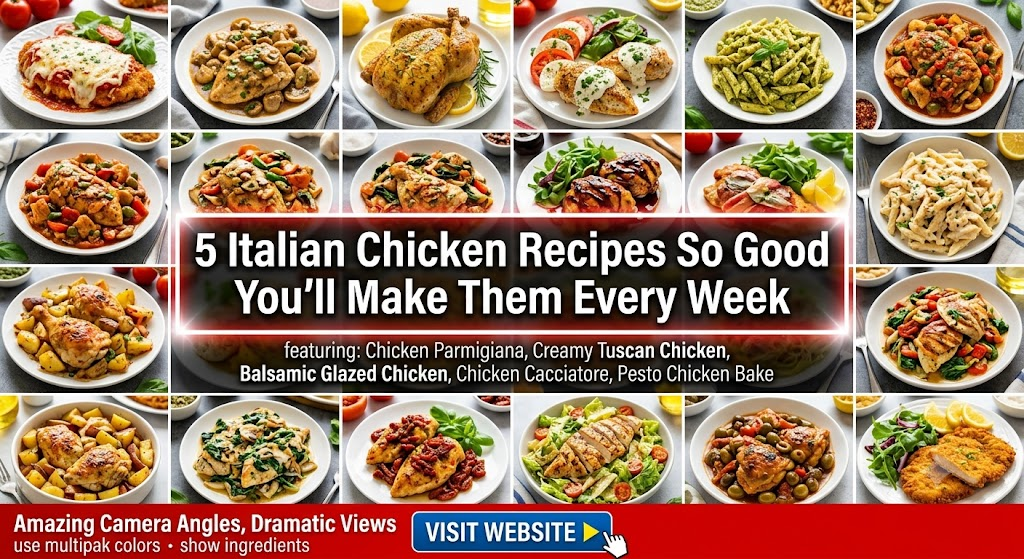
Italian cuisine is more than just food; it is a celebration of life, family, and the profound beauty of simple, high-quality ingredients. While pasta and pizza often steal the spotlight, the art of the secondi piatti (main course)—specifically chicken—holds a prestigious place in the Italian kitchen. From the sun-drenched hills of Tuscany to the bustling trattorias of Rome, chicken is transformed through regional techniques into dishes that are rustic, elegant, and timeless.
In this comprehensive guide, we explore five iconic Italian chicken recipes. These are not merely instructions; they are journeys into the heart of Italian culinary tradition. We will delve into the history, the science of the ingredients, and the precise techniques required to achieve restaurant-quality results at home.
1. The Ultimate Chicken Parmigiana (Pollo alla Parmigiana)
Though many argue about its exact origins—some claiming it as a product of the Italian diaspora in America and others pointing to its roots in the Sicilian Melanzane alla Parmigiana—there is no denying that Chicken Parmigiana is the quintessential “comfort food” of the Italian-inspired world. The secret lies in the contrast: the crunch of the breading, the acidity of the tomato sauce, and the creamy, melted embrace of mozzarella and parmesan.
The Historical Context
The term “Parmigiana” doesn’t necessarily mean it comes from Parma; rather, it often refers to the layering technique similar to the slats of a wooden shutter (parmiciana). While the original dish used eggplant, the adaptation to chicken created a sturdier, protein-rich masterpiece that became a staple of Italian-American Sunday dinners.
Ingredients
For the Chicken:
- 4 boneless, skinless chicken breasts (approximately 1.5 lbs)
- 1 cup all-purpose flour (seasoned with salt and black pepper)
- 3 large eggs, beaten with a tablespoon of water
- 2 cups Panko breadcrumbs (for extra crunch) mixed with ½ cup grated Parmigiano-Reggiano
- 1 tablespoon dried oregano
- 1 teaspoon garlic powder
- Vegetable oil or light olive oil for shallow frying
For the Marinara Sauce:
- 2 tablespoons extra-virgin olive oil
- 3 cloves garlic, minced
- 1 small yellow onion, finely diced
- 1 can (28 oz) San Marzano whole peeled tomatoes (crushed by hand)
- 1 teaspoon dried basil (or 5-6 fresh leaves)
- Salt and crushed red pepper flakes to taste
For the Topping:
- 8 oz fresh mozzarella cheese, sliced or shredded
- ½ cup freshly grated Parmigiano-Reggiano
- Fresh basil leaves for garnish
How to Cook: Detailed Instructions
Step 1: Preparing the Chicken (The Foundation) The most common mistake is using uneven chicken breasts. Place each breast between two sheets of plastic wrap. Using a meat mallet or a heavy skillet, gently pound the chicken until it is an even ½ inch thickness. This ensures the chicken cooks uniformly and stays juicy.
Step 2: The Breading Station (The Crust) Set up three shallow bowls.
- Flour: Dredge the chicken in seasoned flour, shaking off the excess. This acts as the “glue.”
- Egg Wash: Dip the floured chicken into the beaten eggs.
- Breadcrumbs: Press the chicken firmly into the breadcrumb and parmesan mixture. Ensure every nook and cranny is covered. Let the breaded chicken rest on a wire rack for 10 minutes; this helps the breading adhere during frying.
Step 3: Creating the Sauce (The Soul) In a medium saucepan, heat olive oil over medium heat. Sauté the onions until translucent, then add the garlic for 1 minute until fragrant. Pour in the crushed San Marzano tomatoes. Simmer for 20-30 minutes on low heat until the sauce thickens and the sweetness of the tomatoes is concentrated. Adjust seasoning with salt and a pinch of sugar if the tomatoes are too acidic.
Step 4: The Shallow Fry Heat about ½ inch of oil in a large skillet to 350°F (175°C). Fry the chicken cutlets for 3-4 minutes per side until they reach a deep golden brown. Do not overcrowd the pan. Drain on paper towels.
Step 5: The Assembly and Bake Preheat your oven to 400°F (200°C). In a large baking dish, spread a thin layer of sauce. Place the fried chicken on top. Spoon more sauce over the center of each breast (leave the edges bare to maintain some crunch). Top generously with mozzarella and Parmigiano-Reggiano. Bake for 10-15 minutes until the cheese is bubbly and slightly browned. Garnish with fresh basil.
2. Chicken Piccata (Pollo al Limone e Capperi)
Chicken Piccata is the embodiment of “Agrodolce” (sour and sweet) principles, though it leans heavily toward the bright, acidic side. It is a refined, fast-cooking dish that relies on the “Mounting with Butter” (monter au beurre) technique to create a silky, emulsified sauce.
The Chemistry of Flavor
The magic of Piccata happens in the pan. The brown bits (fond) left behind from searing the chicken are deglazed with lemon juice and white wine, creating a complex base. The addition of capers provides “salt pops” that cut through the richness of the butter.
Ingredients
- 4 chicken cutlets (pounded very thin, about ¼ inch)
- ½ cup all-purpose flour
- 4 tablespoons unsalted butter, divided
- 2 tablespoons extra-virgin olive oil
- 1/3 cup dry white wine (Pinot Grigio or Sauvignon Blanc)
- 1/4 cup fresh lemon juice
- 1/4 cup chicken stock (low sodium)
- 3 tablespoons nonpareil capers, rinsed
- 2 tablespoons fresh Italian parsley, chopped
- Lemon slices for garnish
How to Cook: Detailed Instructions
Step 1: Dredging Season your thin chicken cutlets with salt and pepper. Lightly coat them in flour. Unlike the Parmigiana, we want a very thin coating here—just enough to help the sauce cling to the meat later.
Step 2: Searing In a large skillet, melt 2 tablespoons of butter with 2 tablespoons of olive oil over medium-high heat. Once the butter stops foaming, add the chicken. Since they are thin, they only need about 2-3 minutes per side. Remove the chicken to a warm plate.
Step 3: Deglazing the Pan Add the white wine to the hot skillet. Use a wooden spoon to scrape up all those golden bits from the bottom. Let the wine reduce by half. Add the lemon juice, chicken stock, and capers. Bring to a simmer.
Step 4: The Emulsion This is the most critical step. Turn the heat down to low. Add the remaining 2 tablespoons of cold butter to the sauce. Whisk constantly as the butter melts. The goal is to emulsify the fat into the liquid to create a thick, glossy sauce rather than an oily mess.
Step 5: Finishing Return the chicken to the pan for 1 minute to coat it in the sauce. Stir in the fresh parsley. Serve immediately, spooning plenty of the caper-rich sauce over the meat.
3. Authentic Chicken Cacciatore (Pollo alla Cacciatora)
“Cacciatore” means “hunter-style.” Historically, this was a rustic stew prepared by hunters using ingredients found in the woods—onions, herbs, wild mushrooms, and wine. While there are two main versions (the Northern “Bianco” version with wine and vinegar, and the Southern “Rosso” version with tomatoes), we will focus on the hearty, tomato-based version that has become a global favorite.
The Art of the Braise
Unlike the previous recipes, Cacciatore uses bone-in, skin-on chicken pieces. The bone adds depth to the sauce, and the slow simmering process breaks down connective tissue, resulting in meat that falls off the bone.
Ingredients
- 1 whole chicken (approx. 3-4 lbs), broken down into 8 pieces
- Salt and freshly cracked black pepper
- 3 tablespoons extra-virgin olive oil
- 1 large red bell pepper, sliced into strips
- 1 large yellow onion, sliced
- 8 oz cremini mushrooms, sliced
- 3 cloves garlic, smashed
- 1/2 cup dry red wine (like Chianti)
- 1 can (28 oz) crushed tomatoes
- 1/2 cup chicken broth
- 2 sprigs fresh rosemary
- 2 sprigs fresh thyme
- 1/2 cup pitted Kalamata olives (optional, for a Mediterranean punch)
How to Cook: Detailed Instructions
Step 1: The Maillard Reaction Dry the chicken pieces thoroughly with paper towels. Season generously with salt and pepper. In a large heavy-bottomed pot or Dutch oven, heat the olive oil. Sear the chicken in batches, skin-side down first, until the skin is crispy and golden brown. Remove the chicken and set aside. (The chicken will not be cooked through yet).
Step 2: Building the Aromatics In the same pot (don’t wash it!), add the onions and peppers. Sauté until they begin to soften. Add the mushrooms and cook until they release their moisture and turn brown. Add the garlic and cook for just 60 seconds.
Step 3: Deglazing with Red Wine Pour in the red wine. Use your spoon to loosen the caramelized bits on the bottom. Let the wine simmer until it has reduced by about half. This removes the harsh alcohol bite and leaves behind the fruity essence of the grape.
Step 4: The Braise Add the crushed tomatoes, chicken broth, rosemary, and thyme. Place the chicken pieces back into the pot, nestling them into the liquid. Bring to a boil, then reduce the heat to a very low simmer. Cover the pot.
Step 5: Patience Simmer for 45 to 60 minutes. Halfway through, add the olives if using. The sauce should become thick and fragrant. Remove the woody stems of the rosemary and thyme before serving. This dish is even better the next day after the flavors have “married.”
4. Creamy Chicken Marsala (Pollo al Marsala)
Chicken Marsala is a classic “Restaurant Style” dish that feels incredibly luxurious. Marsala is a fortified wine from Sicily, and it comes in “Secco” (dry) and “Dolce” (sweet) varieties. For this recipe, we use Dry Marsala to create a savory, earthy sauce dominated by mushrooms and a hint of creaminess.
The Secret of the Mushrooms
The mushrooms are the star of this dish alongside the chicken. To get the best flavor, you must brown them properly. If you crowd the pan, they will steam instead of sear.
Ingredients
- 4 chicken cutlets, pounded thin
- 1/2 cup all-purpose flour (for dredging)
- 4 tablespoons unsalted butter
- 2 tablespoons olive oil
- 10 oz sliced mushrooms (Cremini or Porcini for best flavor)
- 1 small shallot, minced
- 2 cloves garlic, minced
- 3/4 cup Dry Marsala wine
- 1/2 cup chicken stock
- 1/4 cup heavy cream (optional, for a richer sauce)
- 1 tablespoon fresh thyme leaves
- Salt and pepper to taste
How to Cook: Detailed Instructions
Step 1: Searing the Protein Season and flour the chicken cutlets. In a large skillet over medium-high heat, melt 2 tablespoons of butter with the oil. Sear the chicken until golden on both sides (about 3 minutes per side). Remove the chicken from the pan.
Step 2: The Mushroom Sauté Add another tablespoon of butter to the pan. Add the mushrooms in a single layer. Let them sit undisturbed for 2-3 minutes to develop a deep brown crust. Stir and continue cooking until they are soft. Add the shallots and garlic, cooking until translucent.
Step 3: The Marsala Reduction Pour in the Marsala wine. It will bubble vigorously. Allow it to reduce by half. This step is crucial because it concentrates the sugars in the wine, creating that signature mahogany-colored sauce.
Step 4: Creating the Velouté Whisk in the chicken stock and thyme. If you want a creamy version, whisk in the heavy cream now. Let the sauce simmer for a few minutes until it begins to thicken slightly.
Step 5: Final Toss Return the chicken and any accumulated juices to the skillet. Simmer for 2-3 minutes. The flour from the chicken will help thicken the sauce to a coating consistency (known in French cooking as nappé). Finish with the final tablespoon of cold butter for a glossy shine.
5. Chicken Saltimbocca (Saltimbocca di Pollo)
The name Saltimbocca literally translates to “jumps in the mouth.” Traditionally made with veal, the chicken version is equally spectacular and often more accessible. It is a Roman classic that features three distinct layers: tender chicken, aromatic sage, and salty, crispy prosciutto.
The Synergy of Three Ingredients
The genius of Saltimbocca lies in the interaction between the sage and the prosciutto. As the dish cooks, the sage leaves become embedded in the meat, and the prosciutto renders its fat, essentially “basting” the chicken in a salty, pork-infused essence.
Ingredients
- 4 chicken cutlets, pounded very thin (nearly translucent)
- 4-8 slices of high-quality Prosciutto di Parma
- 8-12 large fresh sage leaves
- All-purpose flour for dredging
- 3 tablespoons unsalted butter
- 2 tablespoons extra-virgin olive oil
- 1/2 cup dry white wine (Orvieto or Frascati are traditional)
- 1/2 cup chicken stock
- Salt and pepper (use salt sparingly, as prosciutto is very salty)
- Toothpicks
How to Cook: Detailed Instructions
Step 1: Constructing the Layers Lay the pounded chicken cutlets flat. Season the top side lightly with pepper (avoid salt for now). Place 2-3 sage leaves on each cutlet. Lay a slice (or two) of prosciutto over the sage, pressing it down so it covers the chicken.
Step 2: Securing the “Jump” Use a toothpick to “weave” through the prosciutto, the sage, and the chicken. This holds everything together during the flipping process. Lightly dredge only the bottom (the non-prosciutto side) of the chicken in flour.
Step 3: The Sear Heat butter and oil in a skillet over medium heat. Place the chicken in the pan, prosciutto-side down first. This might seem counterintuitive, but searing the prosciutto first crisps it up and infuses the oil with its flavor. Cook for 2 minutes, then carefully flip. Cook for another 2-3 minutes until the chicken is done. Remove to a plate.
Step 4: The Pan Sauce Discard any excess fat if there is too much, but keep the brown bits. Increase heat to medium-high and add the white wine. Scrape the pan and reduce by half. Add the chicken stock and a small knob of butter. Whisk until the sauce is slightly reduced and shimmering.
Step 5: Presentation Remove the toothpicks from the chicken. Place the chicken on a platter and pour the light wine sauce over it. The sage should be visible through the crispy prosciutto, providing a beautiful visual and aromatic experience.
The Pillars of Italian Cooking: Tips for Success
To truly master these recipes, one must understand the underlying principles of the Italian kitchen. These are the “hidden” ingredients that separate a good meal from a legendary one.
1. The Quality of Fat
In Italian cooking, fat is flavor. Use high-quality extra-virgin olive oil for finishing and sautéing aromatics, but don’t be afraid of butter. In Northern Italian recipes (like Marsala and Piccata), butter provides the necessary silkiness. Always use unsalted butter so you can control the sodium levels.
2. The Importance of “Mise en Place”
Many of these recipes (especially Piccata and Saltimbocca) cook very quickly. Having your ingredients chopped, measured, and ready (mise en place) is essential. If you are dicing garlic while your butter is browning, you risk burning the fat and ruining the delicate balance of the sauce.
3. Sourcing the Poultry
Since chicken is the canvas for these flavors, the quality of the bird matters. Whenever possible, choose air-dried, organic, or pasture-raised chicken. These birds have less water content, meaning they sear better and have a deeper “chicken” flavor that doesn’t get lost in the sauces.
4. Fresh Herbs vs. Dried
In a long-simmered stew like Cacciatore, dried herbs can work because they have time to rehydrate and release their oils. However, for dishes like Saltimbocca or Piccata, fresh herbs (sage and parsley) are non-negotiable. The volatile oils in fresh herbs provide a top-note of brightness that dried herbs simply cannot replicate.
5. Pasta and Side Pairings
To make these recipes a full meal, pairing is key:
- Chicken Parmigiana: Traditionally served with a side of spaghetti tossed in the same marinara sauce.
- Chicken Piccata: Excellent over a bed of angel hair pasta or alongside roasted asparagus.
- Chicken Cacciatore: Best served with creamy polenta or thick crusty bread to soak up the abundant sauce.
- Chicken Marsala: Pairs perfectly with garlic mashed potatoes or wide ribbon pasta like pappardelle.
- Chicken Saltimbocca: Serve with sautéed spinach with lemon and garlic to cut through the saltiness of the prosciutto.
Conclusion
The beauty of Italian chicken recipes lies in their versatility. Whether you are looking for the rustic, slow-cooked comfort of a Cacciatore on a cold winter night or the bright, zesty elegance of a Piccata for a summer dinner party, these five recipes provide a complete toolkit for the home cook.
By focusing on technique—the perfect sear, the careful reduction of wine, and the balance of acidity and fat—you bring the soul of Italy into your own kitchen. These dishes have survived for generations not because they are complex, but because they are honest. They respect the ingredients and, in turn, provide a dining experience that is both deeply satisfying and full of classic flavor. Buon Appetito!